BIO AND ARTIST'S STATEMENT
Creativity doesn’t run in families – it is a direct result of freedom.

I am April Palmer, a young artist living and working out of a beautiful home in Williston, Vermont. I believe that creative process requires time and awareness.
Below is a long and detailed artist’s statement and bio, but before you begin, there’s two pieces of information you should know.
Firstly, I was homeschooled – meaning that my mother encouraged awareness and adjusted all curricula to my timing and sensibilities. This was due to my mother being exceptional and highly creative – not just my school administrator.
And secondly, my education gave me freedom.
While I have always been creative across many different subjects, my genuine pursuit of art began in early high school, first through pencil and pen before expanding into colored pencil when I took a landscape in art class. I was interested in all areas of realistic art from landscapes to portraiture.
A brief two week art camp was an education in the modern system of teaching art and, indeed, in social consciousness or lack thereof. Teachers entered the classroom with the expectation of speed – which most students could accommodate with ease. I, however, was naturally drawn to detail and intricate study and would have happily spent days painting a two inch portion of a painting expected to be finished in two or three days.
When learning in online formats, I spent hours perfecting assignments. Besides a standard “Intro to Art” course taken through the local high school – where most students attended to receive a checkbox on a piece of paper – this summer camp was, and remains, the only in person course I have taken in art. While the camp was an education in art, most of what I came away with was the fervent desire not to attend art school – and the realization that I didn’t have to.
My next step was to learn to oil paint…
TRANSCENDING OUR CIRCUMSTANCES
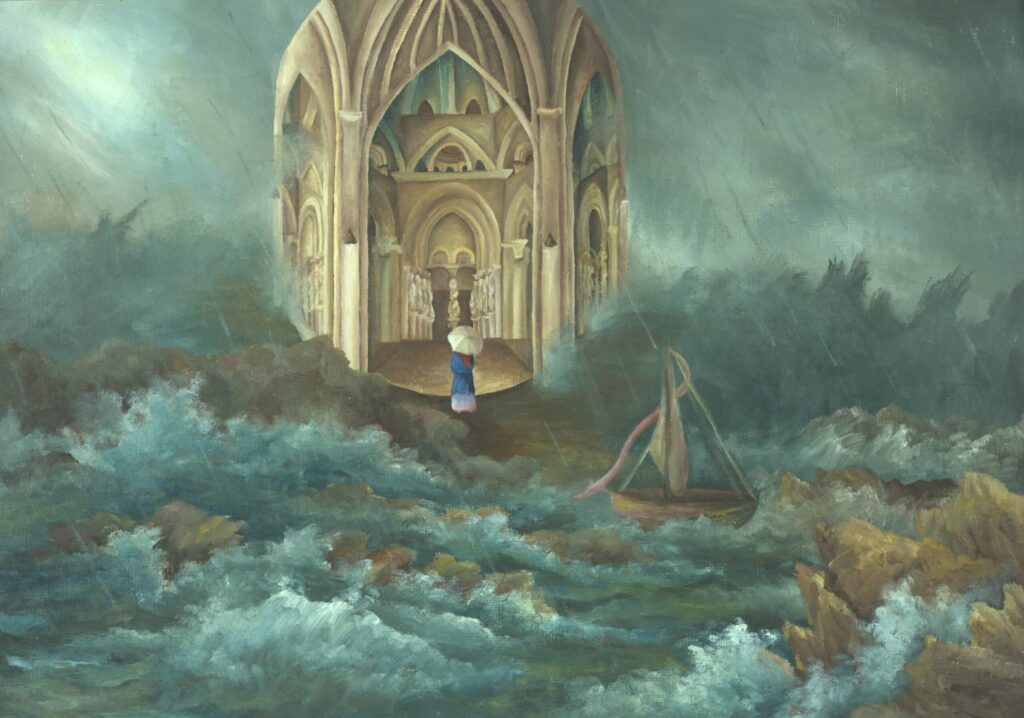
Art is not about a place and time, but rather about an inner experience. What we perceive when we walk in the woods or see beautiful flowers amounts to our level of consciousness in the present moment. Frequently, scenes which I see and take note of in my memory appear quite different when I return for sketches later. What I gather after my initial inspiration is merely the icing on the cake – the detail I so enjoy that fills in my vision.
The latter portion of my high school “career” was during the Covid-19 lockdown which provided me with a unique opportunity to focus. When it is just you, you have the option to tune into yourself or external circumstances beyond your control. This was the choice and my job was to choose where to put my focus and, thereby, my energy. So, I focused on school and art.
Being homeschooled allowed me to direct parts of my schooling to personal interests such as art history which quickly led into a personalized course in oil painting. Just how “custom” was my learning? Well, this oil painting course was so personalized that I was both student and teacher, with some input from my mother, a watercolorist and my school administrator responsible for helping me plan deadlines, etc.
During those years, it was as though I was the world. And the world was my oyster so nothing interrupted my personal rhythm.
Later, I ran a class on Ralph Waldo Emerson and Henry David Thoreau, the “Transcendentalist” group. Since I was basically already living what the Transcendentalists were writing about, the study was perfect at the perfect time. And this is still the case – only now my world encompasses a little more territory.
Science in Art: The Manipulation of our Senses vs. Intuition: The Attraction of Authenticity
The predominant move of the last 100 years of human evolution has been toward a scientific approach to living and understanding what is around us. Scientific perspective in our society has shifted art from an outward expression of an internal state to an outer experience which triggers an internal response: art that attempts to elicit a particular reaction from a viewer by using precise calculations of color, space, etc. In a way, this is a brand of consumerism, where we, the consumer, are manipulated into thinking, feeling, or saying someone else’s agenda. Isn’t art more than “good marketing”?
Art science is merely a new form of what humans have been grappling with for a millennia. Art history is a testament to the hundreds of years long battle for our soul. Whether it was designed to encourage a particular string of thoughts or reinforce societal patterns, art has continually been about directing our attention towards or away from something.
The most notable artists and the ones who created shifts in the consciousness of the masses were those who attuned not to forces outside of themselves but to those inside. I believe that this authenticity is what attracts us to certain artists and makes them stand out in an art history textbook.
“Not for nothing one face, one character, one fact, makes much impression on him, and another none. This sculpture in the memory is not without preestablished harmony. The eye was placed where one ray should fall, that it might testify of that particular ray.” ~ Ralph Waldo Emerson
I believe that true art is created by a child-like understanding and perspective of the world around us. We see more as we open our souls rather than analyze with our minds. This approach to painting and drawing attunes to our personal sensibilities. I do not believe that these values can be taught as they are individual to each person.